
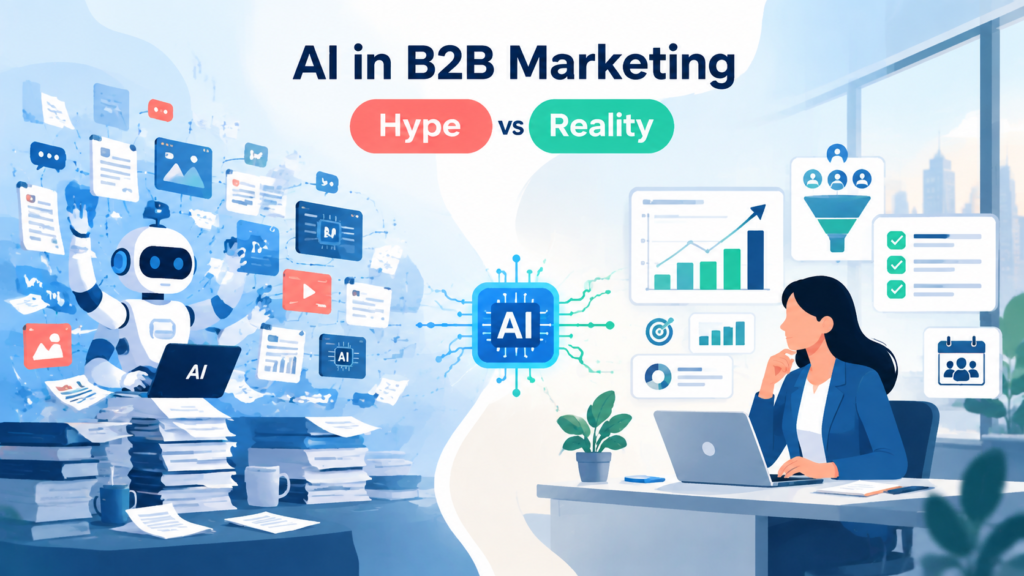
Few topics generate as much noise in B2B marketing strategy discussions right now as artificial intelligence. Scroll through LinkedIn for five minutes and you’ll see claims that AI has already replaced entire marketing teams, that autonomous agents are running full campaigns without human input, and that any company not “AI-first” by now is already obsolete. Scroll a little further and you’ll find the opposite argument that AI is over hyped, under-delivering, and mostly producing generic content that all sounds the same.
The truth, as usual, sits somewhere in between. Recent industry data tells an interesting story: the share of marketers who say they can clearly demonstrate AI’s return on investment has actually gone down over the past year, even as adoption keeps climbing. That’s not a sign AI doesn’t work it’s a sign the bar for proving real business impact has gotten higher, and a lot of teams are still using AI in ways that don’t clear that bar.
This blog is a practical, no-hype breakdown of where AI is genuinely delivering results across core B2B marketing functions B2B lead generation, brand awareness campaigns, digital brand communication, and even corporate events and MICE (Meetings, Incentives, Conferences, and Exhibitions) and where the claims are still outrunning the reality. Whether you’re evaluating AI tools internally or working with a specialist B2B marketing partner to build out your strategy, understanding this distinction will save you budget, time, and credibility.
This distinction matters just as much for an agency juggling multiple B2B client accounts as it does for an in-house marketing team, because the same AI vendor pitches and the same over promises show up in both contexts. The goal of this blog isn’t to tell you whether to use AI. It’s to give you a clear, practical way to evaluate any AI claim against how it actually performs across lead generation, brand awareness, digital communication, and corporate event marketing.
The Current State: AI Adoption Is High, But Confidence in ROI Is Falling
Before getting into specific hype vs. reality claims, it’s worth understanding the broader context. AI adoption across B2B marketing functions has moved well past the experimentation phase the vast majority of top-performing B2B companies now say they’re planning to expand their AI initiatives rather than pull back. Marketing automation platforms, in particular, already see strong day-to-day usage across marketing teams managing everything from B2B lead generation to brand awareness campaigns.
At the same time, a meaningful share of B2B marketers admit they still can’t clearly prove the ROI of their AI investments to leadership. This gap high adoption, but inconsistent proof of value is the central tension defining AI in B2B marketing right now. It’s exactly why separating hype from reality matters, whether you’re managing this in-house or partnering with an outside team to execute it for you.
The Hype: Claims That Don’t Hold Up (Yet)
1. “AI Will Fully Replace Marketing Teams and Agencies”
This is the loudest claim and the least accurate one. The idea that a company can plug in an AI tool and eliminate the need for strategists, writers, designers, and campaign managers doesn’t match what’s actually happening inside high-performing marketing organizations. AI is exceptionally good at specific, bounded tasks drafting a first pass of copy, summarizing research, generating variations of an ad but it consistently struggles with the parts of B2B marketing strategy that require judgment: understanding nuanced buyer psychology, reading the political dynamics of a buying committee, or building a genuinely differentiated brand awareness campaign that stands out rather than blending into the noise.
B2B buying decisions today involve larger, more skeptical buying committees than they did just a couple of years ago, and those committees are actively looking for reasons to trust or distrust a vendor. That kind of trust-building is still a fundamentally human exercise, and it’s exactly where this experienced human judgment earns its value: pairing AI-driven efficiency with human strategic judgment.
2. “Fully Autonomous AI Agents Are Running Campaigns End-to-End”
AI agents are one of the most over-hyped categories in B2B marketing today. The pitch sounds compelling: an agent that plans, executes, and optimizes an entire campaign without human oversight. In practice, most teams claiming to use AI agents this way are actually using them for narrow, well-defined execution tasks monitoring intent signals, trialing inbound leads for a B2B lead generation program, or automating routine data pulls with a human still making the strategic calls.
A useful test for any team evaluating an AI agent vendor pitch: ask exactly what decisions the agent is making autonomously, and what happens when it encounters a situation outside its training data. If the answer is vague, that’s a sign the tool is being oversold. The teams getting genuine value from AI agents have narrowly scoped what the agent decides versus what still requires human sign-off.
3. “AI-Generated Content at Scale Equals a Brand Awareness Strategy”
Volume is not the same as impact. A huge number of B2B marketing teams have used generative AI to dramatically increase content output more blog posts, more social captions, more email variants without a corresponding increase in pipeline or genuine digital brand awareness. The reason is simple: when every competitor in a category is using similar AI tools with similar prompts, the resulting content starts to sound the same.
Brand voice, distinctive point of view, and genuine subject-matter expertise get flattened out, and buyers can tell.
This is particularly important for companies trying to build digital brand awareness and corporate communication in crowded B2B categories, where dozens of competitors are all publishing similar “ultimate guide” content generated with similar prompts. In that environment, sameness is the enemy. AI content works when it accelerates a strategy that already has a clear, differentiated voice not as a substitute for having one.
4. “Buying Any AI Tool Automatically Improves Marketing Performance”
There’s a persistent assumption that adopting AI tools is itself the strategy. In reality, many teams end up “tool stacking” adding AI point solutions on top of existing workflows, including lead generation and event marketing workflows, without ever redesigning the process itself. The result is a more complicated, more expensive tech stack that ships content and campaigns at roughly the same pace as before, just with a bigger software bill.
5. “AI Personalization Just Works Out of the Box”
Personalization is one of the most promised benefits of AI in B2B marketing, and one of the most overstated. AI-driven personalization is only as good as the data feeding it, and most B2B companies simply don’t have clean, complete account-level and engagement data yet. Without that foundation, “AI personalization” often just means slightly smarter mail-merge, not the deep, dynamic tailoring the marketing decks promise a gap that affects everything from email nurture sequences to personalized invitations for corporate events and MICE programs.
The Reality: Where AI Is Genuinely Delivering Value
1. AI in B2B Lead Generation and Demand Generation
This is one of the clearest, most measurable wins for AI in B2B marketing. AI-driven forecasting and scoring models are helping B2B lead generation teams identify which prospects are most likely to convert, and predictive analytics are outperforming traditional manual forecasting methods in terms of accuracy. For any B2B lead generation company or in-house demand generation team, this means marketing and sales budgets can be allocated toward accounts that are actually showing buying signals, rather than spread evenly across a broad, unqualified list.
This is also reshaping how B2B demand generation agencies structure their campaigns. Instead of running one broad campaign aimed at an entire target market, AI-powered intent monitoring lets demand generation teams identify in-market accounts in real time and prioritize outreach accordingly a meaningful efficiency gain for any organization running B2B demand generation services at scale.
2. AI-Powered Account Prioritization for Brand Awareness Campaigns
Rather than generating more generic content, some of the most effective AI applications in 2026 are being used to identify which accounts and audiences are most likely to respond to a brand awareness campaign and to tailor messaging and channel selection accordingly. This shift means brand awareness spend is increasingly directed toward audiences with a genuine reason to engage, rather than broad, undifferentiated reach, making digital brand awareness and corporate communication efforts measurably more efficient.
3. AI Chatbots and Lead Qualification
AI-powered chatbots have quietly become one of the most practical, ROI-positive applications of AI in B2B lead generation. Rather than trying to replace a sales conversation, the strongest use cases involve chatbots that qualify inbound leads, route them to the right sales rep based on real-time intent and account context, and cut response times dramatically compared to manual triage. This is a good example of AI succeeding by doing one job well speed and routing rather than trying to replace the entire sales conversation. Prospects get immediate engagement instead of waiting hours or days, and sales teams get pre-qualified, context-rich leads instead of a raw form submission.
4. Marketing Automation and Workflow Efficiency
Marketing automation platforms remain one of the most consistently adopted and genuinely useful applications of AI across B2B marketing strategy. The majority of B2B marketing teams already use these platforms in some capacity for lead nurturing, campaign scheduling, and reporting. Where there’s still room to grow is in adopting the more advanced, AI-powered features within these platforms many teams use automation tools for basic workflows without tapping into the predictive or generative capabilities already built in.
5. Real-Time Campaign Optimization
AI’s ability to analyze campaign performance data in real time and adjust targeting, bidding, or messaging accordingly is one of the more understated wins in digital marketing. Multiple independent analyses now show AI-driven campaigns consistently outperforming traditionally managed campaigns on conversion rates and cost efficiency a meaningful advantage for agencies running paid campaigns for B2B clients alongside organic lead generation and brand awareness efforts.
6. Content Assistance (Not Content Replacement)
Used correctly, generative AI is a genuine productivity multiplier for B2B content teams accelerating research, generating first drafts, summarizing long reports, and repurposing a single piece of content into multiple formats for different channels. The teams getting real value here treat AI as a drafting and acceleration tool that a human editor still shapes, fact-checks, and infuses with brand voice not as an autonomous replacement for the content or communication strategy itself.
Where AI Meets Corporate Events, MICE, and Trade Show Marketing
One area that doesn’t get enough attention in the AI-in-marketing conversation is live, in-person B2B engagement corporate events, MICE programs, trade shows, and networking events. This is worth addressing directly, because for many B2B companies, corporate events remain one of the highest-converting parts of the marketing mix, and AI is starting to change how these programs are planned, promoted, and measured.
AI in B2B Conference and Seminar Planning
For companies running B2B conference and seminar planning in Mumbai or other major business hubs, AI tools are increasingly used to forecast attendance, automate registration and follow-up communication, and analyze which content topics and speaker formats are likely to draw the most engaged audience. This doesn’t replace the strategic work of curating a compelling agenda it removes administrative friction so planning teams can focus on the parts of event strategy that actually require human judgment.
AI and B2B Hybrid Event Services
B2B hybrid event services are a natural fit for AI-driven personalization. AI can help tailor the virtual attendee experience recommending sessions, enabling smart networking matches between in-person and remote attendees, and analyzing engagement data from both audiences in real time. For companies investing in hybrid formats to extend the reach of a single flagship event, this data layer is quickly becoming a genuine differentiator between a hybrid event that feels like an afterthought and one that feels intentionally designed for both audiences.
AI in B2B Networking Event Services
AI-powered matchmaking is one of the more practical, proven applications of AI at B2B networking events. Rather than leaving attendees to network randomly, AI tools can analyze attendee profiles, company data, and stated interests to suggest relevant introductions turning a standard networking reception into a more intentional, high-value experience for attendees and sponsors alike.
AI in B2B Trade Show Marketing
For B2B trade show marketing, AI is being used to identify which prospects visiting a booth are highest-value based on firmographic and behavioral data, and to prioritize post-show follow-up accordingly. This helps trade show teams avoid the common problem of collecting hundreds of business cards or badge scans and then treating every lead with the same level of follow-up urgency, regardless of actual fit or intent.
AI for Corporate Event Management Companies
For a corporate event management company in India or elsewhere, AI-driven tools are increasingly used across the planning lifecycle from predictive budgeting and vendor comparison to real-time attendee feedback analysis during multi-day corporate meetings and incentive event services. Used well, these tools free up event planning teams to focus on the experiential and relationship-building elements of an event that no algorithm can replicate.
The overall pattern here mirrors what’s true across every other part of B2B marketing: AI adds the most value when it removes administrative friction and surfaces better data for human decision-makers not when it’s expected to replace the strategic and relationship-driven work that makes corporate events and MICE programs effective in the first place.
Why the Gap Between Hype and Reality Matters Right Now
The stakes of getting this distinction wrong are rising, not falling. B2B buyers themselves have become measurably more skeptical of AI-driven marketing claims, and buying committees which now often include well over a dozen stakeholders on a single purchase decision are scrutinizing vendors’ AI claims against actual proof points rather than taking them at face value. Overpromising AI capability, whether in a marketing campaign, a lead generation program, or a corporate event pitch, is increasingly likely to erode trust rather than build it.
At the same time, unchecked or ungoverned use of generative AI carries real reputation and financial risk for B2B brands from factual errors in AI-generated content to messaging that fails to reflect genuine brand differentiation. This is pushing many organizations to introduce clearer AI governance policies: guidelines around what AI can and can’t be used for, human review requirements before publication, and accountability for accuracy.
None of this means B2B marketers should be cautious to the point of inaction. It means the winning approach in 2026 isn’t “adopt as much AI as possible” or “avoid AI entirely” it’s building a clear-eyed framework for where AI adds real, measurable value across lead generation, brand awareness, and event marketing versus where it’s simply the trend of the moment.
A Practical Framework: How to Separate Hype from Real Value
If you’re a B2B marketing leader trying to make sensible decisions about where to invest in AI whether for B2B lead generation, brand awareness campaigns, or corporate event management a few practical filters can help:
1. Does it solve a bounded, well-defined problem? AI performs best on specific, repeatable tasks with clear inputs and outputs lead scoring, campaign bid optimization, chat-bot routing, event attendance forecasting. Be skeptical of any AI application pitched as solving an open-ended, judgment-heavy problem end-to-end.
2. Is there a measurement plan before you start? If you can’t clearly define what success looks like pipeline influenced, response time reduced, event ROI improved before deploying an AI tool, you’ll struggle to prove ROI after the fact.
3. Does it depend on data you don’t actually have? Many AI personalization and demand generation promises quietly assume you already have clean, complete, unified account and engagement data. If that data doesn’t exist yet, fixing the data foundation should come before investing further in AI-driven layers built on top of it.
4. Does it preserve human judgment where judgment matters most? The strongest AI implementations use AI to execute a system a human has designed not to replace the strategic thinking, relationship-building, or creative direction behind that system, whether it’s a lead nurture sequence or a corporate conference agenda.
5. Is it built for how buyers actually behave in 2026? With buying journeys getting longer and buying committees getting larger, any AI marketing investment digital or event-based should be evaluated against how today’s B2B buyers actually research and decide, not how they did three years ago.
What This Means for Your B2B Marketing Strategy
The organizations getting real value out of AI in B2B marketing in 2026 share a common pattern: they’ve stopped treating AI as a single silver-bullet solution and started treating it as a set of specific tools, each suited to a specific job. Predictive forecasting for B2B lead generation, intent-based account prioritization for brand awareness campaigns, chatbot-driven lead qualification, and AI-assisted planning for corporate events and MICE programs are delivering measurable results because they’re applied to narrow, well-defined problems with clear success metrics.
Meanwhile, the organizations struggling to show ROI are often the ones that adopted AI broadly and quickly, without redesigning workflows, without a clean data foundation, and without a clear view of what “success” was even supposed to look like. The lesson isn’t to slow down AI adoption it’s to be far more deliberate about where, why, and how it’s applied across every part of the marketing mix, from digital campaigns to live corporate events.
Frequently Asked Questions About AI in B2B Marketing
Is AI actually delivering ROI in B2B marketing, or is it mostly hype?
Both are true, depending on the use case. AI delivers strong, measurable ROI in narrow, well-defined applications like predictive B2B lead generation scoring, intent-based account prioritization for brand awareness campaigns, chatbot lead qualification, and real-time campaign optimization. It delivers far less value and often no measurable ROI at all when used broadly for mass content generation or fully autonomous campaign management without a clear strategy behind it.
Can AI improve B2B demand generation results?
Yes, when applied correctly. AI-powered intent monitoring helps B2B demand generation agencies and in-house teams identify in-market accounts in real time, so outreach and content are directed toward prospects actively researching a solution rather than a broad, unqualified audience. This makes B2B demand generation services measurably more efficient, though it still depends on having clean underlying account and engagement data.
Does AI have a role in planning corporate events and MICE programs?
Increasingly, yes. AI tools are being used across corporate event management, B2B conference and seminar planning, and B2B hybrid event services to forecast attendance, automate registration and follow-up, personalize the attendee experience, and analyze engagement data in real time. AI doesn’t replace the strategic and relationship-driven work of event planning it removes administrative friction so planning teams can focus on experience design and stakeholder relationships.
How is AI changing B2B trade show marketing and networking events?
For B2B trade show marketing, AI helps identify which booth visitors are highest-value based on firmographic and behavioral data, improving how sales teams prioritize follow-up after the show. At B2B networking events, AI-powered matchmaking tools can suggest relevant introductions between attendees based on company data and stated interests, making networking more intentional than leaving it to chance.
Should a B2B company work with a marketing partner to figure out its AI strategy?
For many B2B companies, especially those without a dedicated internal team to evaluate and integrate AI tools, working with an experienced outside marketing team can help separate genuinely useful AI applications from vendor hype, and ensure new tools are integrated into a redesigned workflow rather than simply added on top of an existing one.
Final Thoughts
AI is neither the marketing revolution some vendors claim nor the overhyped bubble its critics describe it’s a genuinely powerful set of tools that deliver real results when applied to the right problems, with the right data, and with human judgment still firmly in the loop. This holds true whether you’re running a B2B lead generation program, planning a B2B conference and seminar in India or neighbouring countries, executing B2B trade show marketing, or building a long-term brand awareness campaign.
The B2B marketing teams that will pull ahead over the next few years won’t be the ones who adopted AI the fastest. They’ll be the ones who understood the difference between AI that replaces thinking and AI that executes a well-designed strategy faster.
If your team is trying to figure out where AI genuinely fits into your B2B marketing strategy from B2B lead generation and demand generation to corporate event management and trade show marketing it’s worth starting with a clear-eyed audit of your current tools, data foundation, and measurement approach before adding anything new to the stack. As a B2B marketing partner working across digital campaigns, demand generation, and corporate events and MICE programs, this is exactly the kind of strategic groundwork we help clients build before recommending any new technology investment.